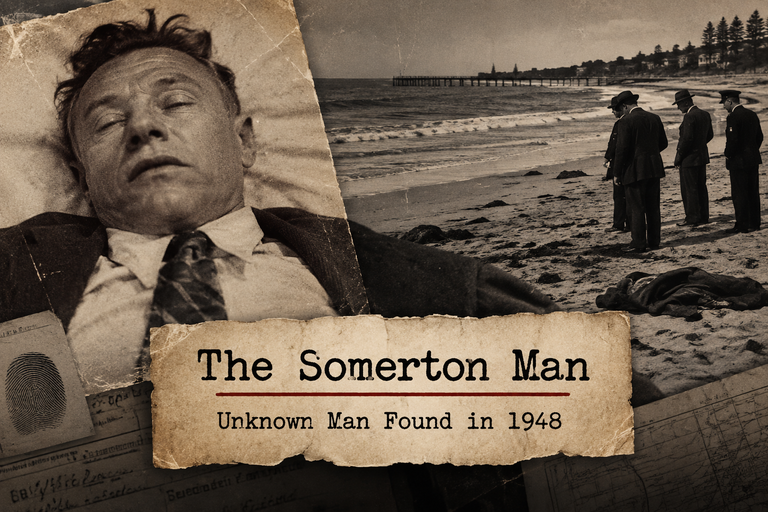
The Somerton Man — Unknown Man Found in 1948
On the morning of December 1, 1948, the body of a well-dressed man was discovered on Somerton Beach near Adelaide, South Australia. He carried no conventional identification and nobody initially came forward who could reliably name him. He appeared to be about forty years old, was clean-shaven, and was dressed in relatively formal clothing. For more than seven decades he would be known simply as the Somerton Man. Modern genetic-genealogy research has produced a strong identification as Carl 'Charles' Webb, although official coronial confirmation remained pending in 2026.
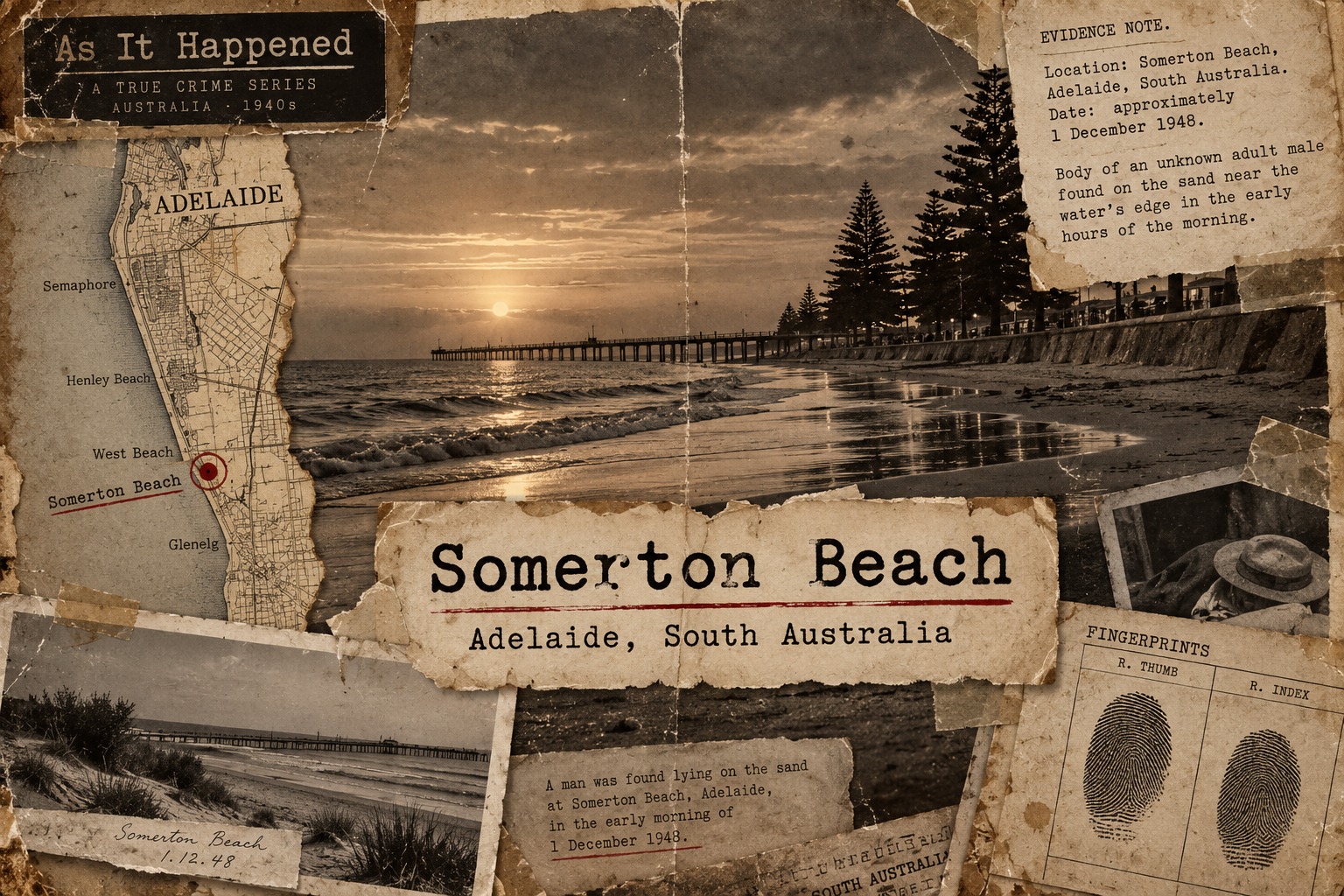
Somerton Beach Adelaide South Australia
Somerton Beach is the Adelaide-area shoreline where the unidentified man's body was found on December 1, 1948. He was positioned near the seawall, giving the appearance at first glance of someone sleeping or resting. The location became the geographical center of the mystery. Later clues would lead investigators to nearby Glenelg and to Adelaide Railway Station, expanding what initially appeared to be an unexplained beach death into a much larger puzzle.
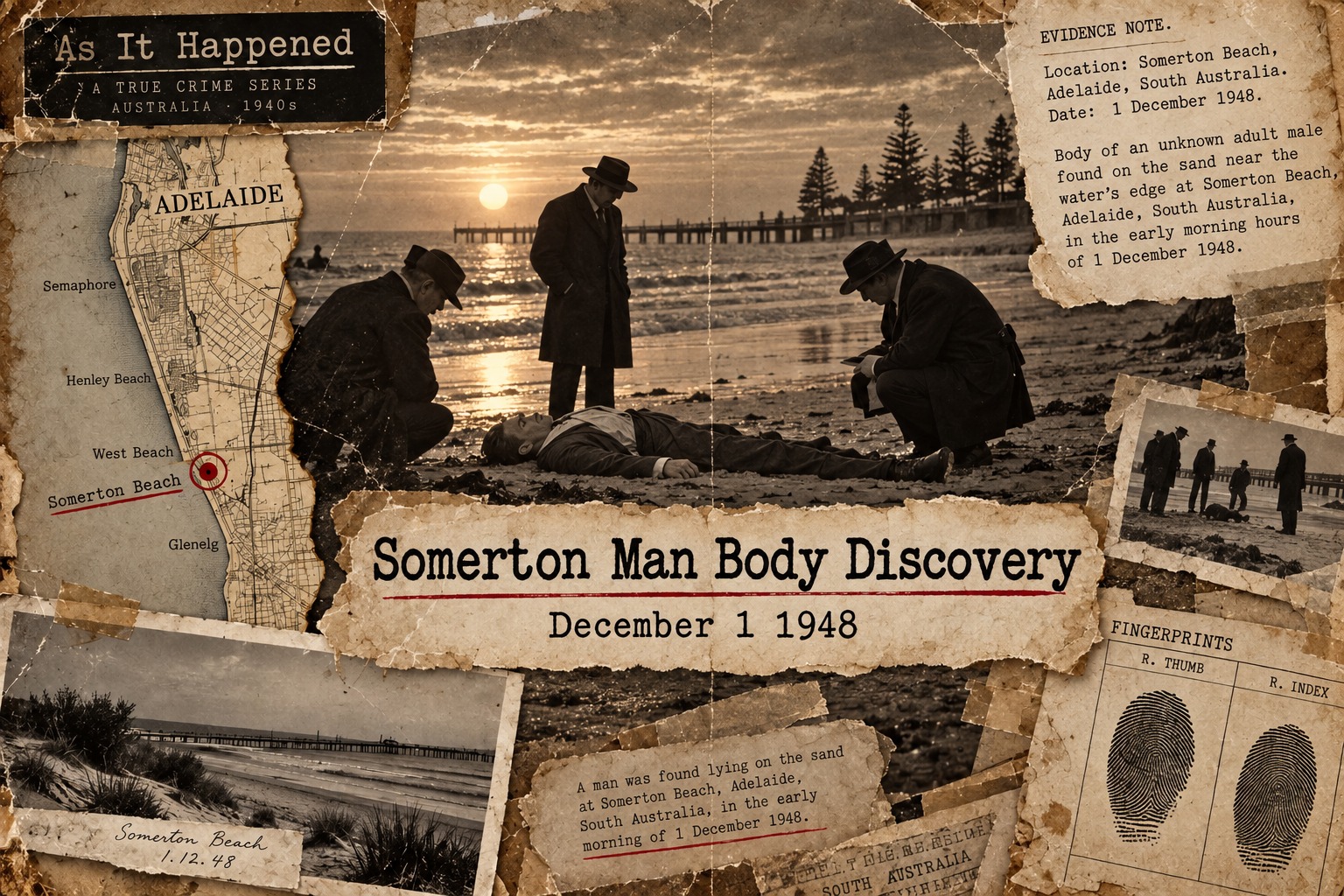
Somerton Man Body Discovery — December 1 1948
At approximately 6:30 in the morning on December 1, 1948, the man was found dead at Somerton Beach. People had reported seeing a man in the same general position the previous evening, but his condition had not caused immediate alarm. When the body was examined, there was no wallet or obvious identification. The discovery began one of Australia's longest-running unidentified-person investigations.
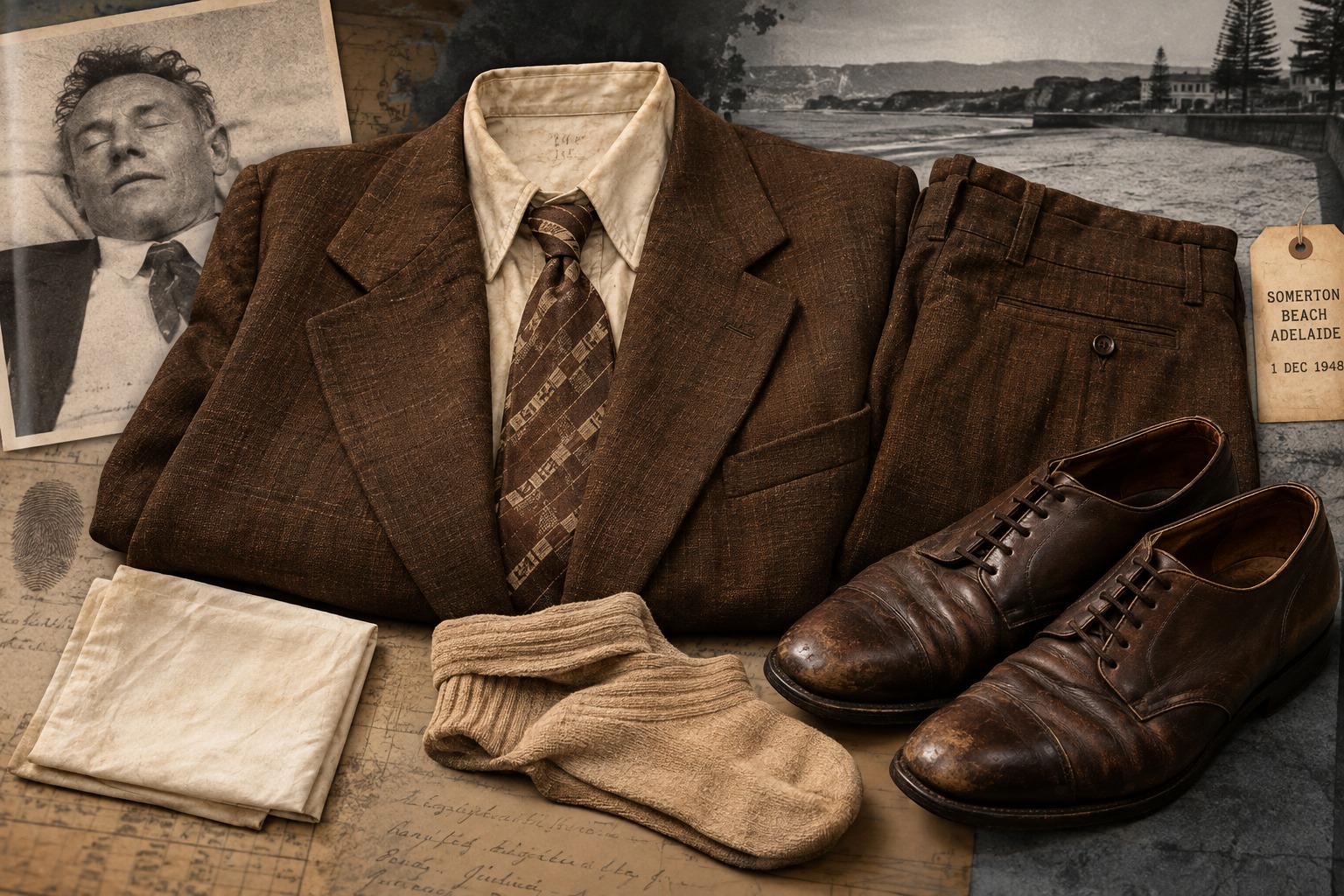
Somerton Man Brown Suit and Clothing
The dead man was smartly dressed, including a suit, shirt, tie, trousers, polished shoes, and other clothing appropriate for the period. Investigators found that identifying labels had been removed from many items. That detail generated suspicion because it made tracing ownership more difficult. However, label removal alone does not prove espionage or deliberate concealment; it remains an unusual feature that must be interpreted alongside the rest of the evidence.
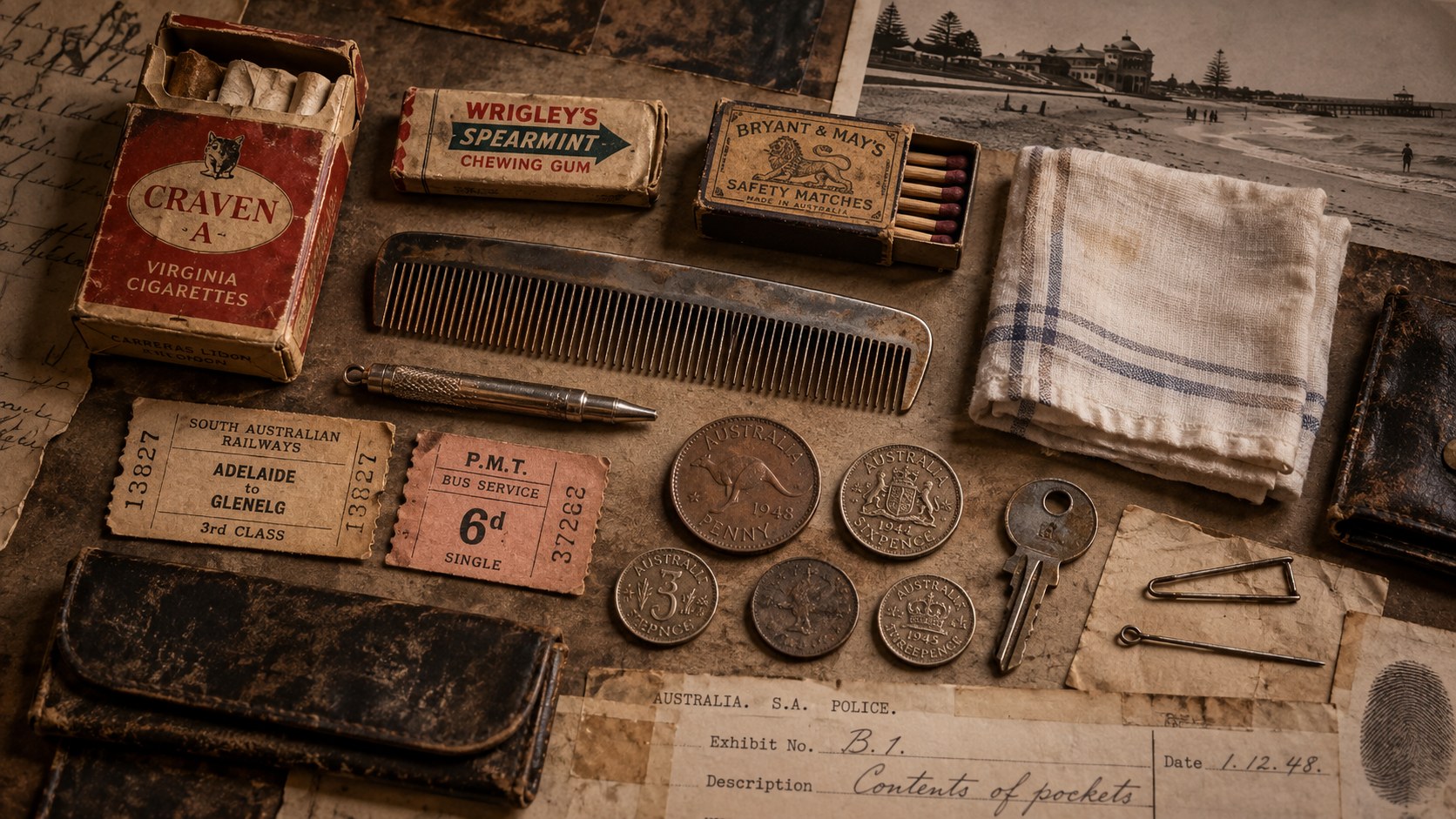
Somerton Man Pocket Contents and Personal Items
Among the ordinary items associated with the dead man were cigarettes, matches, chewing gum, combs, and transport tickets. None immediately supplied his identity. The contrast between mundane pocket contents and the complete absence of conventional identification contributed heavily to the mystery. These small objects also helped investigators reconstruct at least part of his final movements in Adelaide.
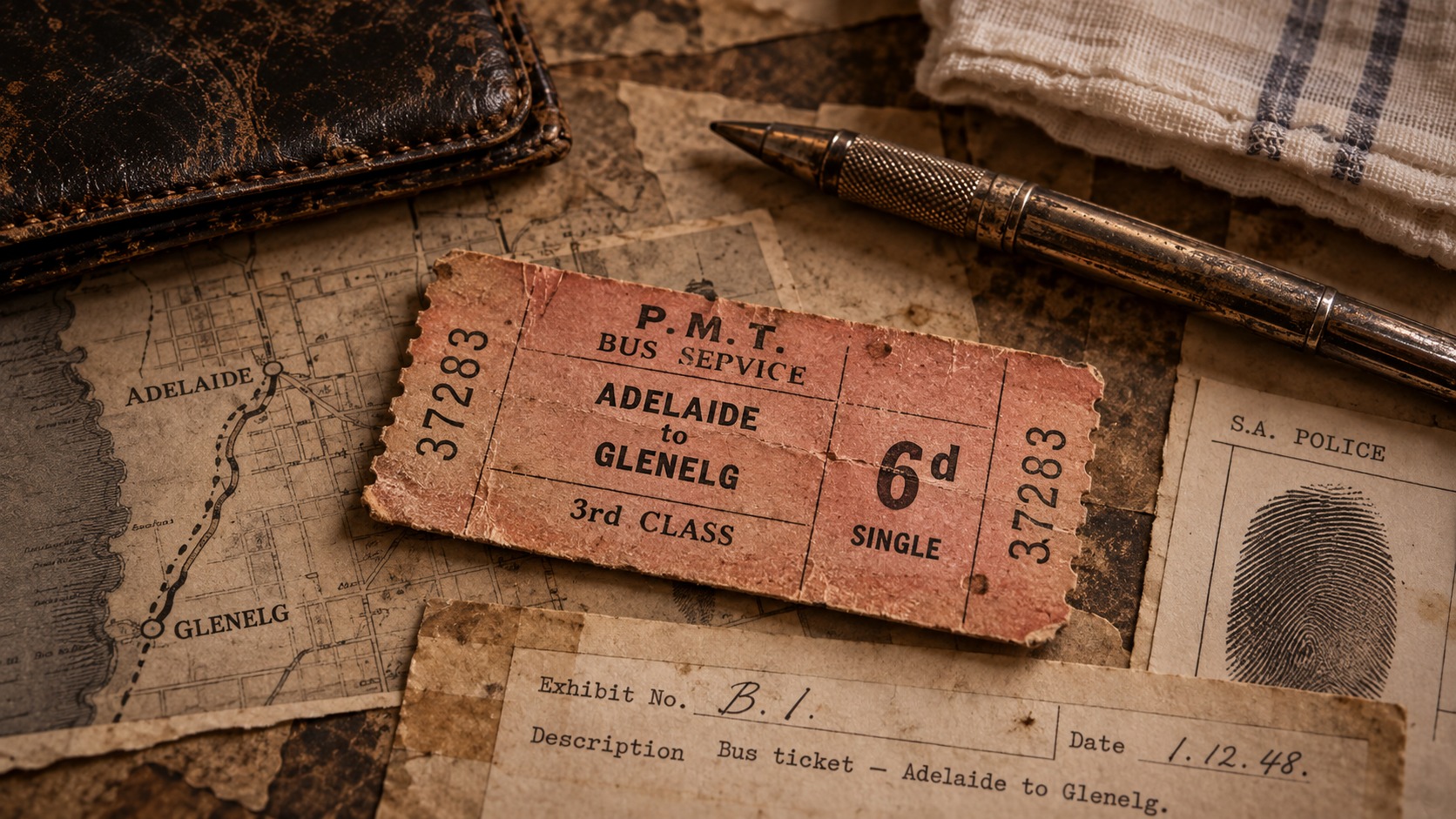
Somerton Man Bus Ticket to Glenelg
A used bus ticket found among the man's possessions indicated travel from central Adelaide toward the beach area on November 30, 1948. The ticket became part of the reconstruction of his final known day. Investigators concluded that he had travelled from the vicinity of Adelaide Railway Station toward the coastal suburbs. The ticket is important because it places an otherwise unidentified man into a specific sequence of movement only hours before his death.
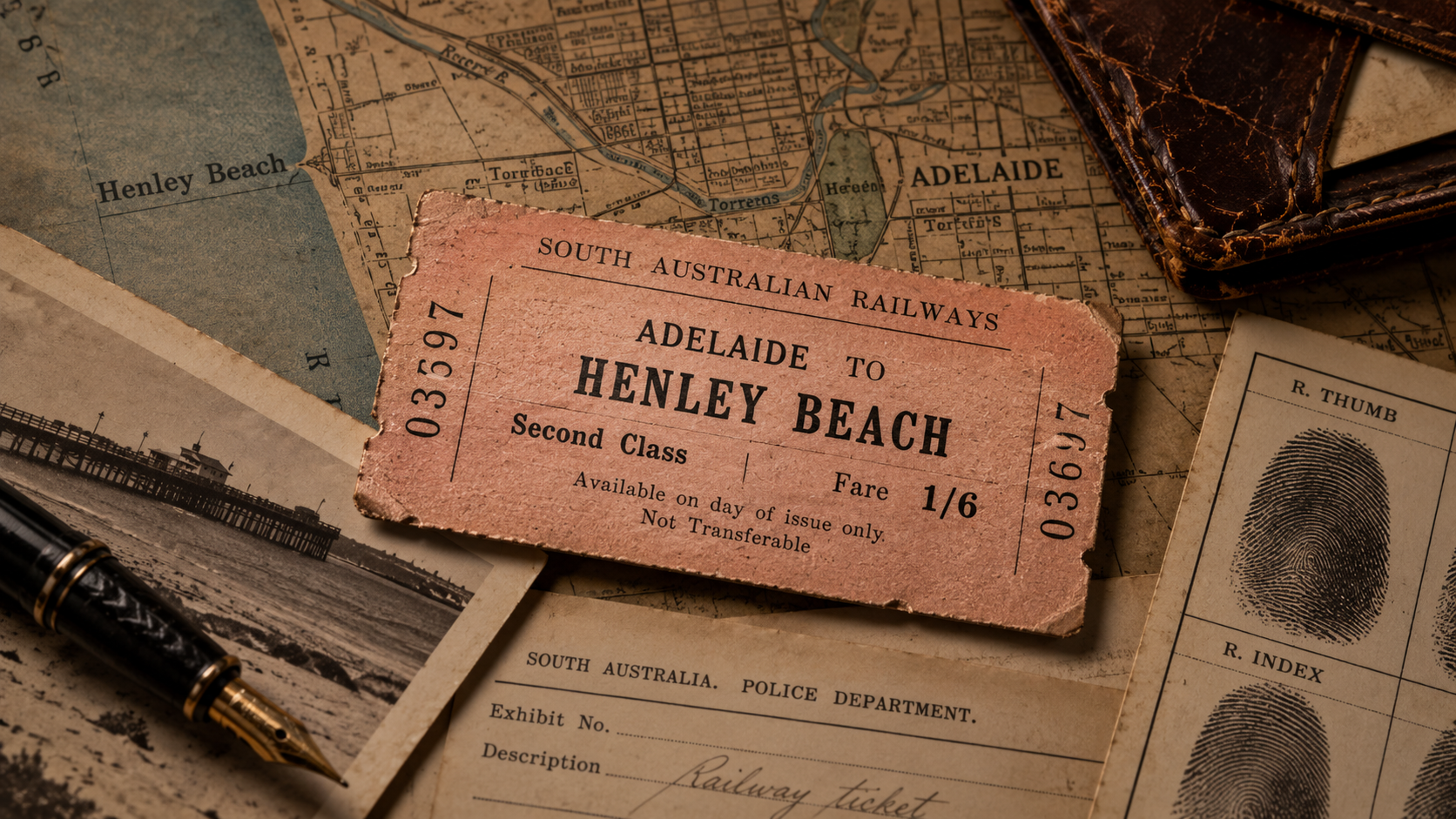
Unused Adelaide to Henley Beach Train Ticket
Investigators found an unused railway ticket among the man's possessions. Evidence presented at the original inquest indicated that he had purchased a train ticket but did not use it, suggesting that his travel plan changed during November 30. The combination of an unused train ticket and a used bus ticket became an important part of efforts to reconstruct how he moved from Adelaide Railway Station toward Somerton.
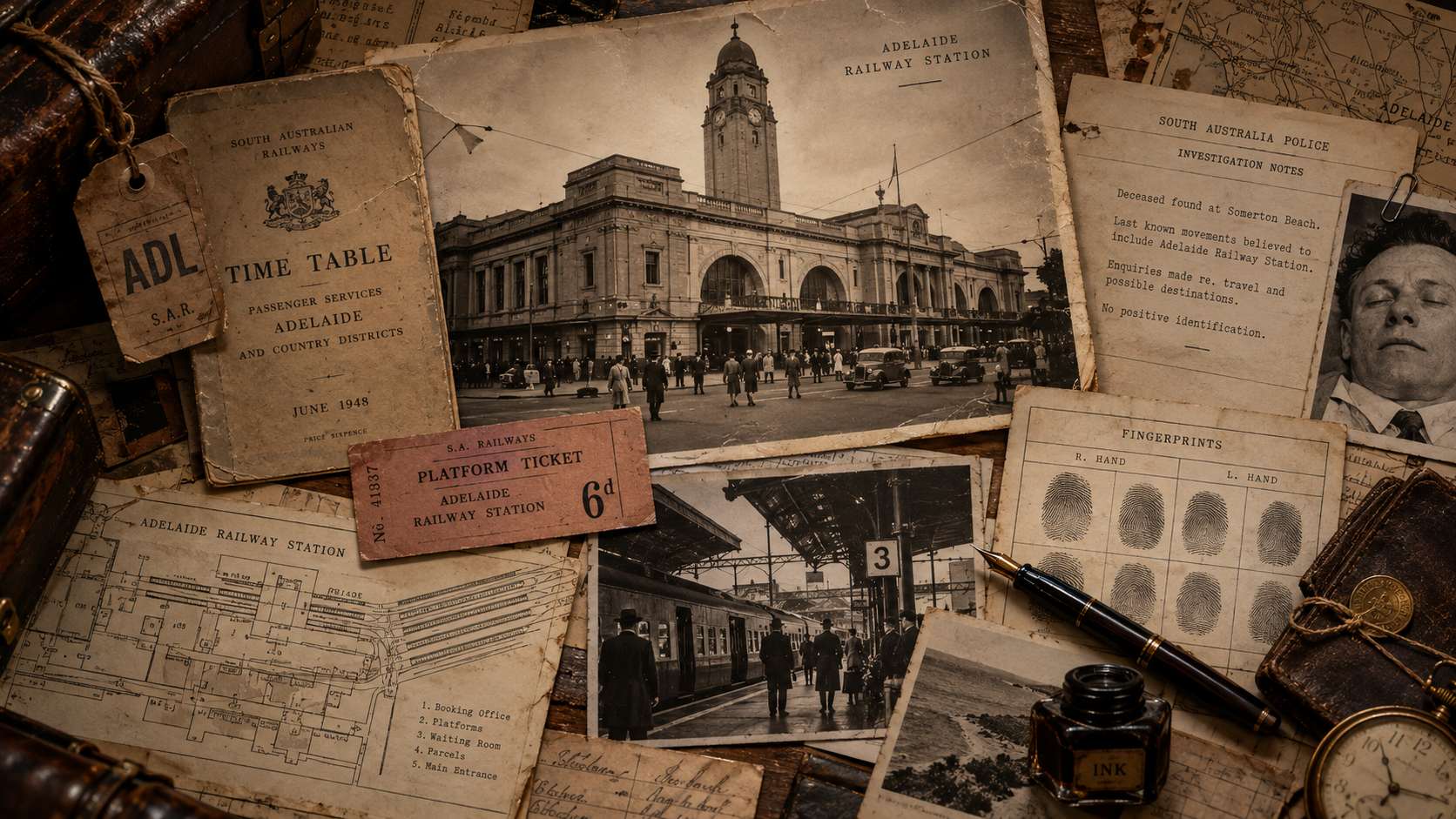
Adelaide Railway Station — Somerton Man Connection
Adelaide Railway Station became a crucial location in the investigation. The man's transport tickets suggested that he had been there on November 30, and investigators later located a suitcase left in the station cloakroom that they believed belonged to him. This gave police a second collection of belongings to examine and provided clues suggesting that the man had arrived in Adelaide carrying luggage before travelling toward the beach.
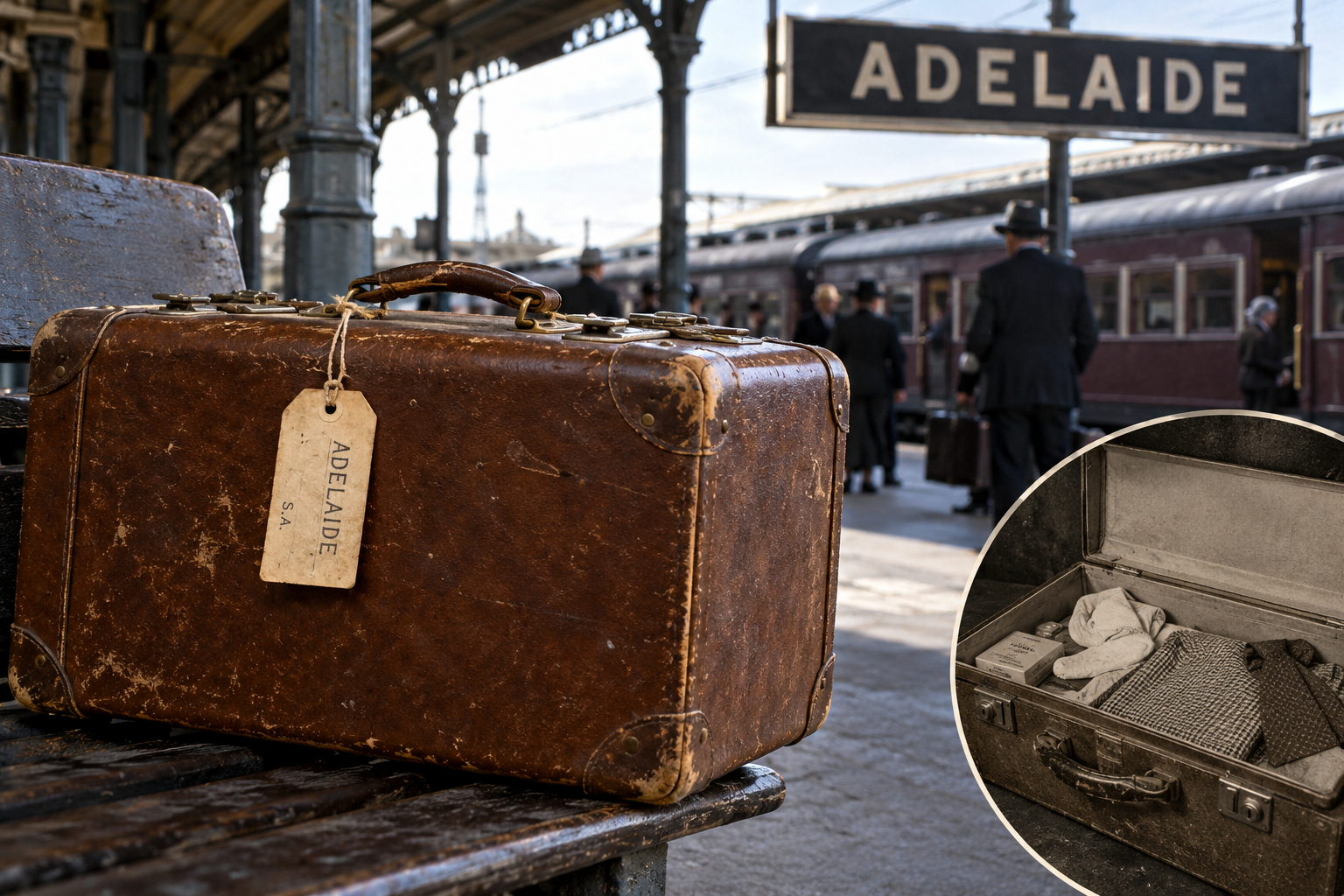
Somerton Man Brown Suitcase — Adelaide Railway Station
A brown suitcase believed to belong to the Somerton Man was located in the cloakroom at Adelaide Railway Station in January 1949. It had reportedly been deposited before the body was found. Inside were clothing, personal-care items, tools and other belongings. As with clothing on the body, identifying labels had largely been removed. The suitcase became one of the largest collections of physical evidence connected to the unidentified man.

Keane and T. Keane Clothing Labels
Several items connected with the suitcase carried versions of the name Keane, including 'T. Keane.' Investigators originally pursued the possibility that this was the dead man's name but failed to identify him through that lead. After Carl Webb was proposed through genetic genealogy, researchers noted that Webb had close family connections to the Keane family, offering a plausible explanation for why clothing bearing that name might have been among his possessions.
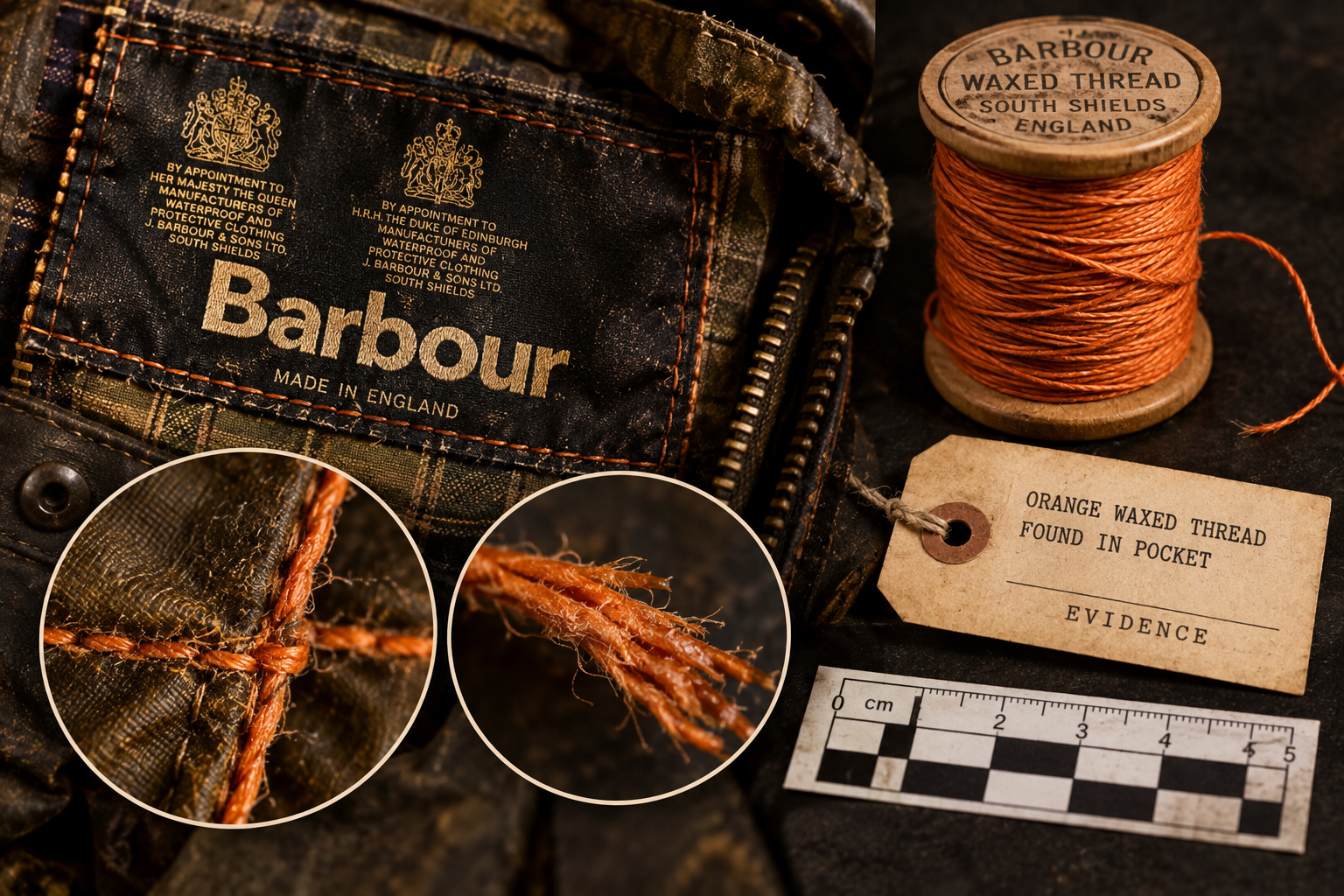
Barbour Orange Waxed Thread Evidence
Investigators noticed unusual thread among the belongings in the railway-station suitcase and linked it to repairs made to the man's clothing. The thread was considered unusual in Australia at the time. This helped strengthen the connection between the suitcase and the body, turning an otherwise anonymous piece of luggage into evidence associated with the deceased man.
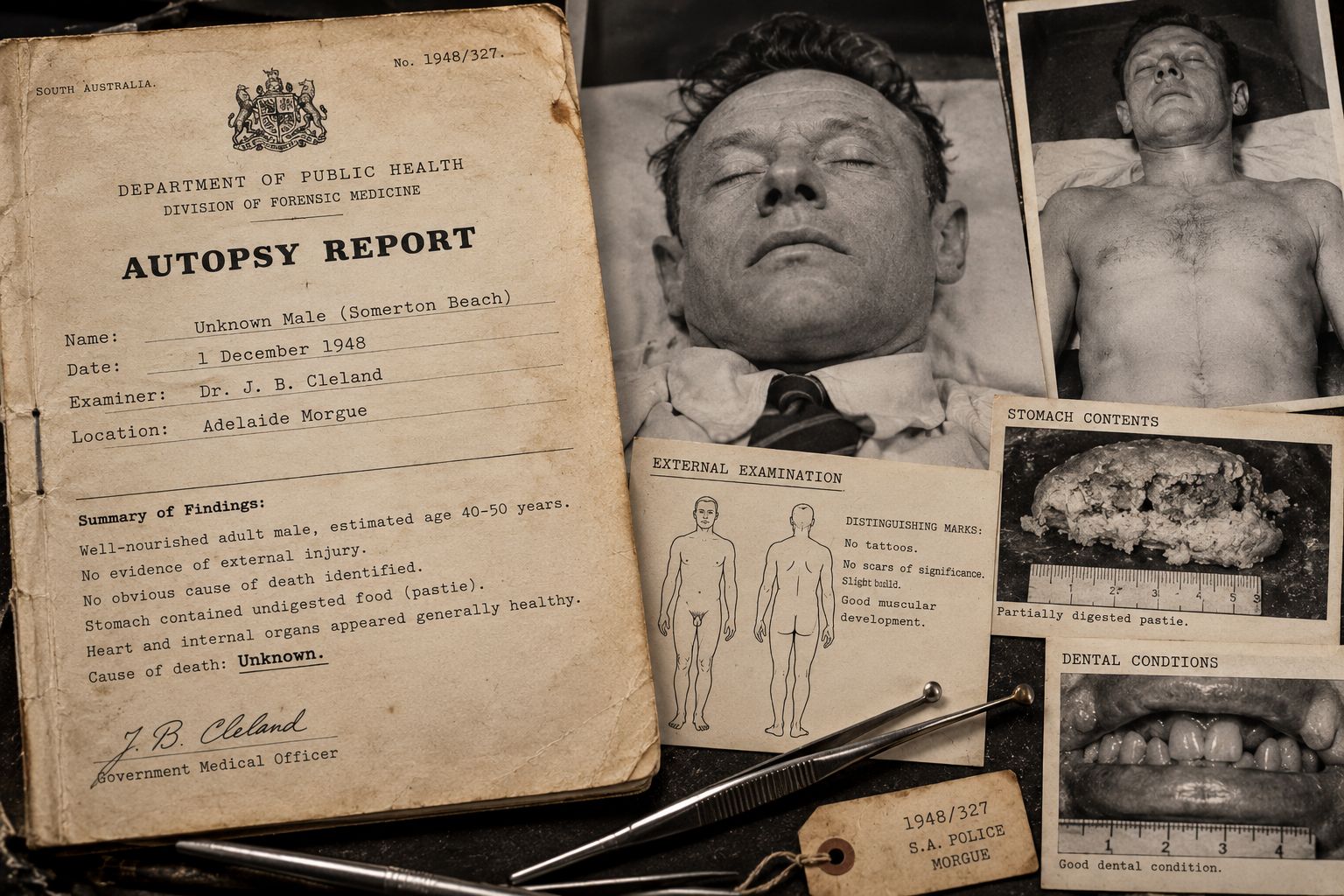
Somerton Man 1948 Autopsy Findings
The post-mortem examination revealed unusual internal findings, including congestion and bleeding within organs and an enlarged spleen. Investigators and medical witnesses considered poisoning a serious possibility. Tests did not identify a common poison, however, and no specific toxic substance was established. The original investigation therefore ended without a medically proven cause of death, leaving poisoning as a significant hypothesis rather than a confirmed mechanism.
What Caused the Somerton Man's Death?
The cause of death remains one of the most important unresolved questions. Medical evidence in 1949 caused investigators to suspect poison, possibly an uncommon substance that could not be detected using the available testing methods. Yet no poison was identified. Decades later, the exhumed remains offered an opportunity for modern examination, but determining a chemical cause of death after so much time is exceptionally difficult. Accident, natural disease, suicide and deliberate poisoning have all been considered in discussions of the case.
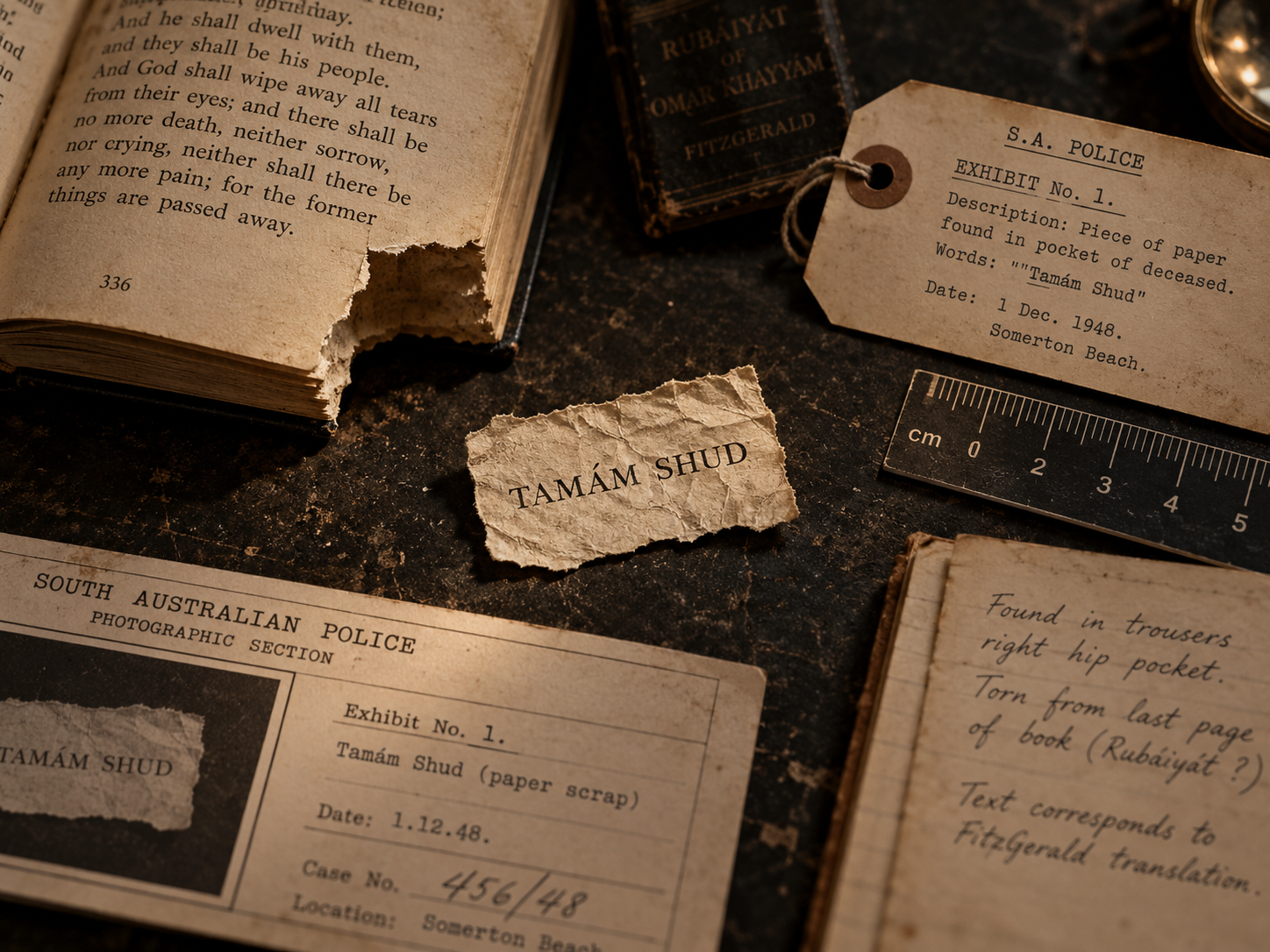
Tamám Shud Paper Scrap Found on Somerton Man
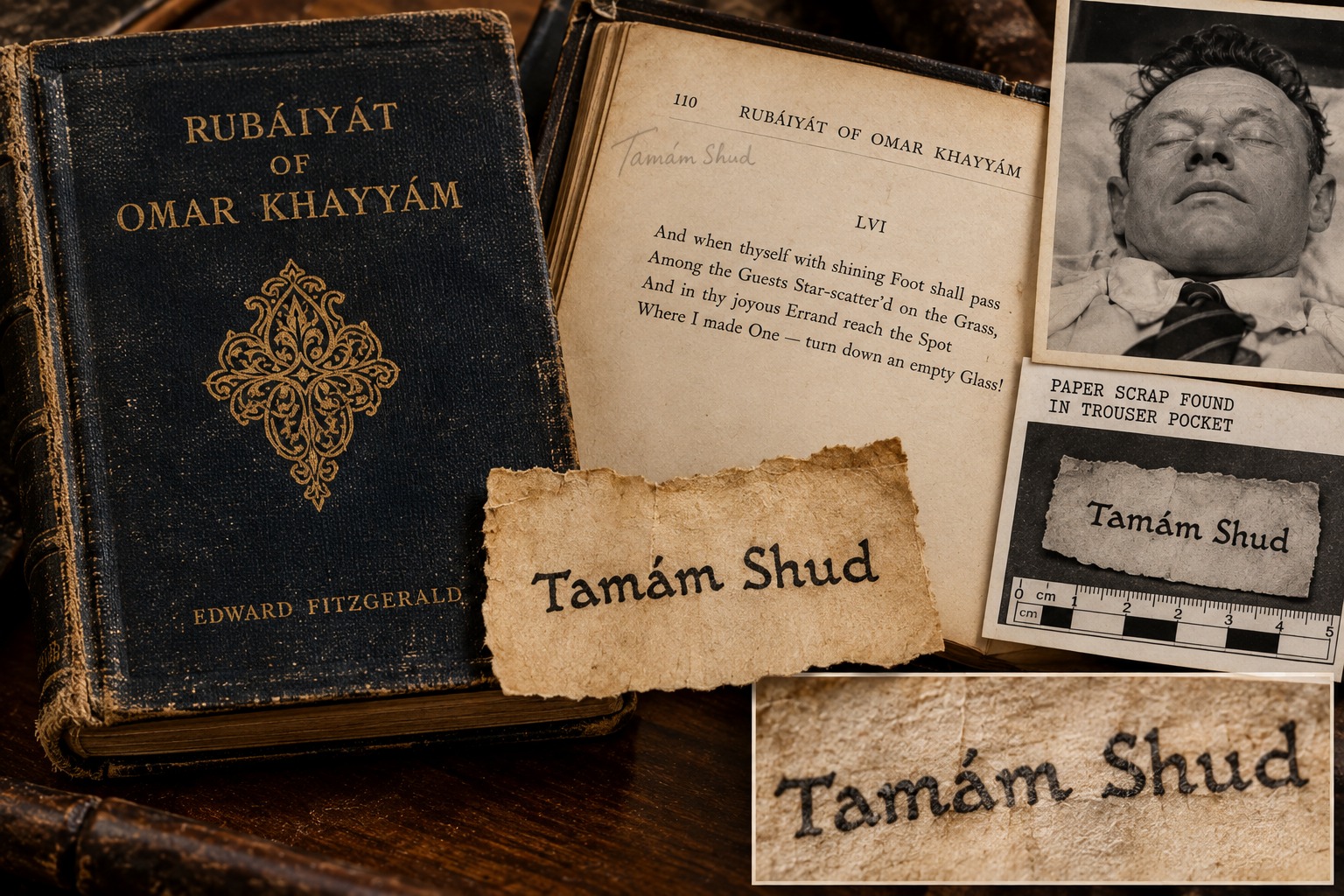
Months after the death, investigators discovered a tiny tightly rolled piece of paper concealed in a small fob pocket of the man's trousers. Printed on it were the words 'Tamám Shud,' commonly translated as 'ended' or 'finished.' Investigators recognized the phrase as the concluding words of the Rubáiyát of Omar Khayyám. The scrap transformed the investigation, supplying the mysterious phrase by which the case would become internationally known.
Rubáiyát of Omar Khayyám Linked to Somerton Man
Police eventually received a copy of the Rubáiyát of Omar Khayyám that had reportedly been found inside or near a car in the Glenelg area around the period of the death. Its final page had been torn, and investigators linked the missing section to the Tamám Shud scrap found on the body. The book then produced two further mysteries: a telephone number and several lines of faint handwritten letters on its back pages.
Somerton Man Rubáiyát Mystery Code
Faint capital letters discovered in the back of the Rubáiyát appeared in several short lines and have often been described as a secret code. Cryptographers and researchers have examined them for decades without producing a universally accepted solution. They may represent a cipher, initials, a mnemonic, betting notes, or something else entirely. The writing is one of the most recognizable pieces of evidence in the case, but its actual meaning has never been reliably established.
Jessica Thomson Telephone Number in the Rubáiyát
A telephone number found in the Rubáiyát was traced to a woman living in the Glenelg area, close to where the Somerton Man had died. The discovery created one of the investigation's most intriguing personal connections. Police interviewed the woman, Jessica Thomson, but no definitive relationship between her and the dead man was established. Why her number was associated with the book remains an unresolved question.
Jessica Thomson — Jestyn — Somerton Man Witness
Jessica Ellen Thomson, sometimes referred to in accounts of the case as Jestyn, lived in the Glenelg area near Somerton Beach. Her telephone number was discovered in the copy of the Rubáiyát associated with the investigation. Police questioned her in 1949. She denied knowing the dead man. Her proximity to the beach and connection to the book generated decades of speculation, but no proven evidence established that she caused his death or knowingly participated in a crime.
Somerton Man Plaster Death Mask
Before burial, a plaster cast was made of the Somerton Man's head and upper body so investigators would retain a three-dimensional representation of his appearance. The death mask became a famous artifact of the case. Decades later it assumed unexpected scientific importance when hairs embedded in the plaster were examined for DNA. Those hairs ultimately became central to the genetic-genealogy research that identified Carl Webb as the likely Somerton Man.
Somerton Man 1949 West Terrace Cemetery Burial
Unable to identify the man, authorities buried him at West Terrace Cemetery in Adelaide in June 1949. His grave became a physical memorial to one of Australia's most enduring mysteries. The burial did not end the investigation. Photographs, records, the death mask and surviving evidence continued to be studied for decades as investigators and private researchers attempted to establish who he had been.
Carl Charles Webb — Proposed Somerton Man Identity
Carl, commonly called Charles, Webb was born in Victoria in 1905 and later worked in technical occupations including electrical and instrument work. In 2022 researchers Derek Abbott and Colleen Fitzpatrick announced that forensic genetic genealogy strongly identified Webb as the Somerton Man. Their reconstruction connected DNA from hairs associated with the death mask to Webb's extended family. As of 2026, however, South Australia's coronial process had not yet issued a final public determination confirming the identity.
Dorothy Jean Webb — Charles Webb's Wife
Dorothy Jean Webb was the wife of Carl 'Charles' Webb. Historical records uncovered after Webb was proposed as the Somerton Man showed that their marriage had broken down and that she later sought divorce on grounds including desertion. Her later presence in South Australia has drawn attention from researchers attempting to understand why Webb might have travelled to Adelaide. The evidence does not establish that he went there specifically to find her, but the possibility is part of the reconstructed background.
Professor Derek Abbott — Somerton Man Researcher
University of Adelaide researcher Professor Derek Abbott spent many years investigating the Somerton Man case. His work included studying surviving evidence, tracing genealogy and obtaining hairs associated with the plaster death mask for DNA analysis. In 2022 he and forensic genealogist Colleen Fitzpatrick announced that their genetic research identified the Somerton Man as Carl 'Charles' Webb. Abbott has emphasized that solving the identity does not automatically explain the death.
Colleen Fitzpatrick — Forensic Genealogist
Forensic genealogist Colleen Fitzpatrick worked with Derek Abbott on the effort to identify the Somerton Man. Genetic genealogy uses DNA matches from relatives together with documentary family trees to narrow an unknown person's identity. In this case the technique pointed researchers toward Carl 'Charles' Webb and relatives from both sides of his family. Their conclusion represented the most significant breakthrough in the case since 1949.
Somerton Man DNA Genetic Genealogy Evidence
DNA recovered from hair associated with the Somerton Man's plaster death mask was used to construct a genetic profile suitable for genealogical comparison. Researchers combined those genetic matches with extensive family-tree research and concluded that Carl 'Charles' Webb was the best match. The result is scientifically compelling and is widely regarded as the leading identification, but the official South Australian coronial process remained separate from the researchers' conclusion as of 2026.
Somerton Man 2021 Exhumation
In May 2021 South Australian authorities exhumed the Somerton Man's remains from West Terrace Cemetery as part of a renewed effort to establish his identity using modern forensic methods. The exhumation represented an extraordinary reopening of a case more than seventy years old. Police and forensic authorities began their own scientific examination, separate from the independent genetic-genealogy work that would publicly point to Carl Webb the following year.
Charles Webb Family Photographs
After Carl Webb was identified by researchers, members of the Webb family located historical photographs showing a man labelled Charlie. The images provided something the mystery had lacked for generations: photographs of the proposed Somerton Man while alive. Researchers and relatives considered the appearance consistent with the man found at Somerton Beach, although visual resemblance by itself is not identification evidence and is secondary to the genetic work.
Is the Somerton Man Officially Carl Charles Webb?
The strongest modern answer to the identity mystery is Carl 'Charles' Webb. Genetic genealogists announced the identification in 2022 and expressed extremely high confidence in their result. South Australia Police nevertheless continued a formal coronial investigation. As of July 2026 police said that investigation was still ongoing and that a report would ultimately be provided to the coroner. The distinction between a powerful research identification and a finalized official determination is important.
Why Did Charles Webb Travel to Adelaide?
If Carl Webb was the Somerton Man, one of the largest remaining mysteries is why he travelled from Victoria to South Australia. His separated wife Dorothy later had a connection to South Australia, providing one possible avenue of inquiry, but no surviving evidence conclusively explains his journey. He may have travelled for personal reasons, employment, reconciliation, recreation, or some purpose that has disappeared from the historical record.
Why Did the Somerton Man Have the Tamám Shud Scrap?
Why was a tiny scrap reading 'Tamám Shud' hidden in the man's clothing? The phrase means something like 'finished' or 'ended' and was torn from the final page of the Rubáiyát. It may have carried personal significance, served a practical purpose, reflected a literary interest, or been connected to the circumstances of his death. The dramatic wording has encouraged elaborate theories, but the evidence does not reveal what the scrap meant to the man himself.
What Does the Somerton Man Mystery Code Mean?
The lines of capital letters found in the Rubáiyát have resisted a definitive interpretation for decades. Numerous cryptographic solutions have been proposed, but none has achieved broad evidentiary acceptance. Some researchers believe the letters may be initials rather than encrypted text. A more recent suggestion is that they could relate to horse-racing notes, consistent with information uncovered about Charles Webb, but this remains a theory rather than a proven decoding.
Why Was Jessica Thomson's Number in the Rubáiyát?
The presence of Jessica Thomson's telephone number in the book is one of the case's enduring personal mysteries. She lived only a short distance from where the man died, but denied knowing him when questioned by police. Was the number written by the Somerton Man, by the owner of the book, or by somebody else? Did it represent a personal acquaintance, an attempted contact, or an unrelated notation? No definitive answer has survived.
Was the Somerton Man Connected to Espionage?
The case emerged at the beginning of the Cold War, involved an unidentified man, removed clothing labels, mysterious writing and an unexplained death. Those features encouraged theories that the Somerton Man might have been a spy. Yet no conclusive evidence has established an intelligence connection. The espionage theory is historically important because it shaped public fascination with the case, but it must remain separate from facts actually demonstrated by the evidence.
What Happened During the Somerton Man's Final Hours?
Transport evidence and witness accounts allow investigators to reconstruct portions of November 30, 1948, but not the crucial final sequence. The man appears to have travelled from central Adelaide toward the coast and was seen on or near the beach that evening. Who he met, what he consumed, why he remained there, and exactly when he became incapacitated are unknown. Those missing hours contain the likely explanation for his death.
What Really Happened to the Somerton Man?
Modern DNA research may have supplied the man with a name, but it has not supplied the ending to his story. Why did Charles Webb come to Adelaide? What was his relationship, if any, to Jessica Thomson? Why was the Tamám Shud scrap hidden in his clothing? What did the writing in the Rubáiyát mean? And most importantly, what caused his death? The identity mystery may be approaching resolution while the mystery of what happened remains very much alive.